
In New Zealand, conventional wisdom says first term governments get re-elected. Indeed, the last time a first-term government failed to be re-elected was in 1975. But with the election now officially called for 7 November, where does this government stand in its prospect for re-election?
Christopher Luxon’s (National Party, Centre-right) government has got off to a rocky start, but currently, they remain favoured to win re-election. In the polls released in the last month, the coalition government has led the opposition parties by 2 to 6 points.
But for a first term government, it is polling unusually poorly, and if Preferred PM numbers are anything to go by, Christopher Luxon may well be a drag on his own party’s prospects. It’s perhaps not surprising, then, that Luxon was subject to much speculation about a leadership challenge last year — and why Labour (Centre-left) believes they can make this a one term government.
Historic Trends
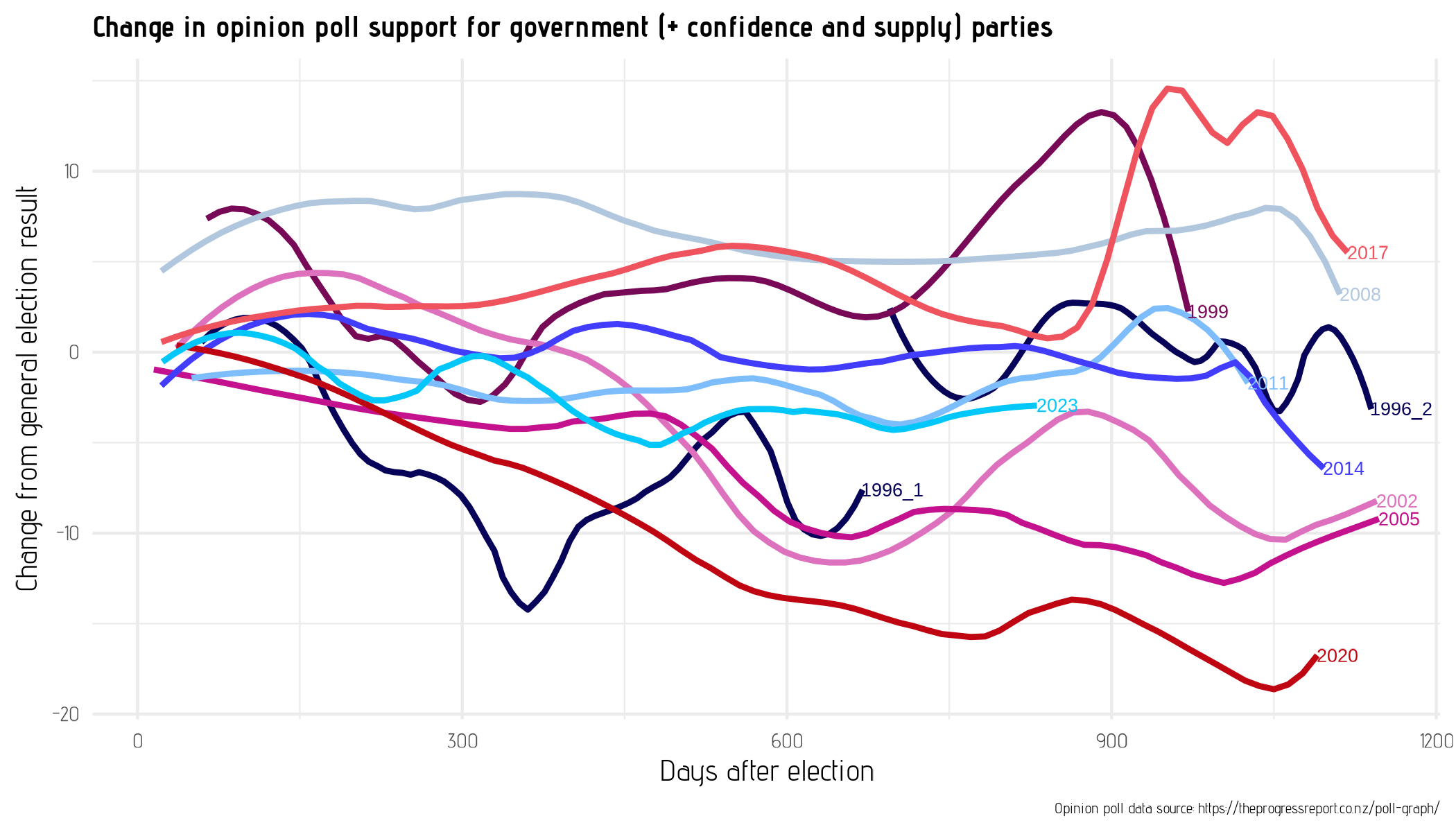
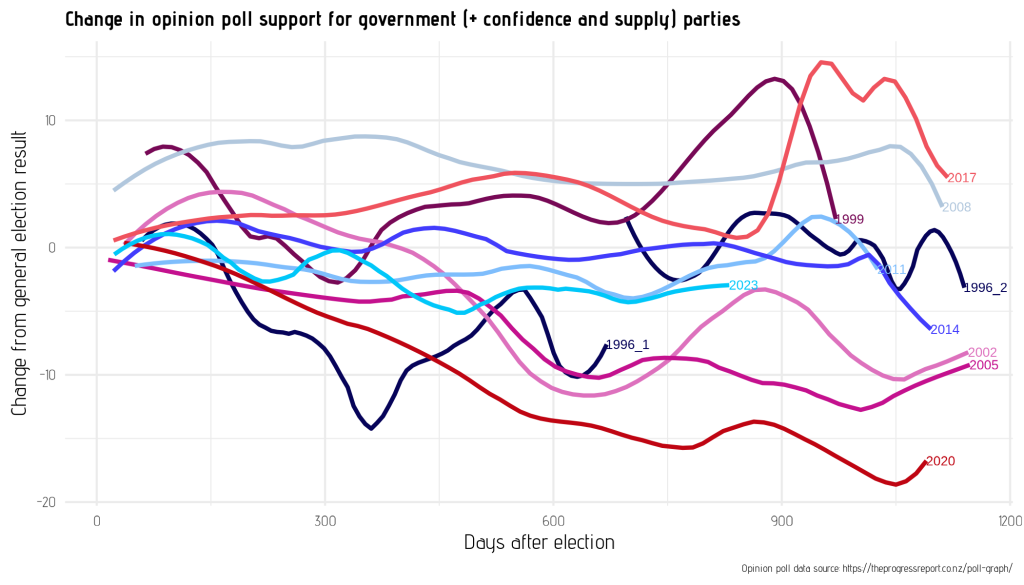
To make better sense of the opinion polls, they need to be put in a historical context — seeing where other governments were polling at this time in the parliamentary term. New Zealand switched from First Past the Post to Mixed Member Proportional starting in the 1996 election. Looking at governments since that switch, the Luxon coalition sits in the middle of the historic trends around changes in incumbent government support since the previous election.
Support for the coalition has been broadly steady for the past year. Its support is down since the 2023 election, but only marginally, and it’s well above the threshold that would see them lose re-election.
However, among first terms, the Luxon government does stand out. Of the three first term governments in the MMP era (Helen Clark 1999-2002, John Key 2008-2011, Jacinda Ardern 2017-2020), the current coalition government polls the worst.
Luxon’s government is also the only first-term government to lose support at the 750 day mark post-election. the government has seen a recent uptick in support and could well end up gaining support by the election, for now it is down 2.5 points since the 2023 election.
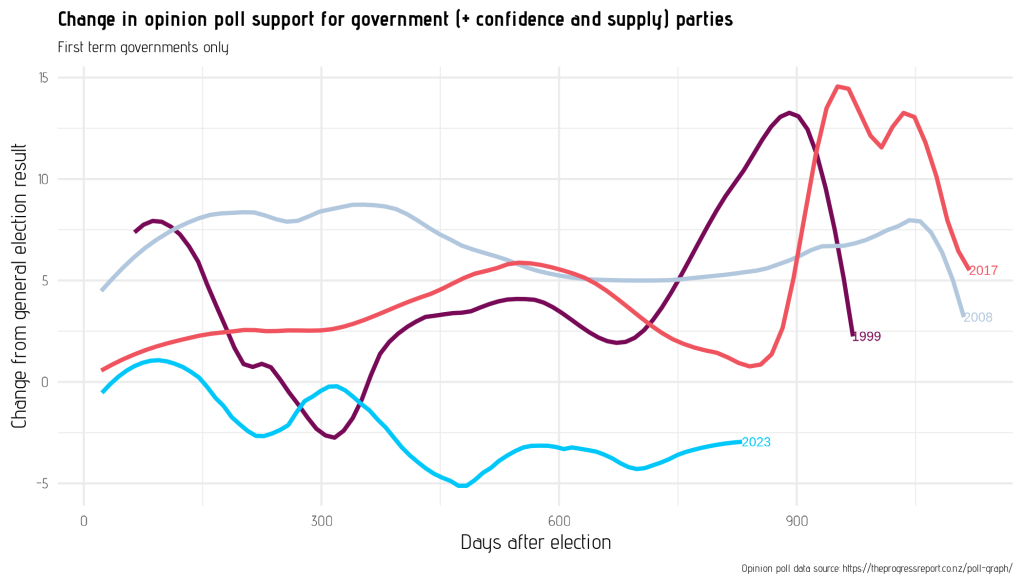
Additionally, there tends to be more movement in the opinion polls during campaign periods when more people are paying attention and parties are under greater media scrutiny. For the Luxon government, while they can go into an election only 3 points down since 2023 and still be ahead of the opposition, it puts them in a position where they are vulnerable to last minute swings in support.
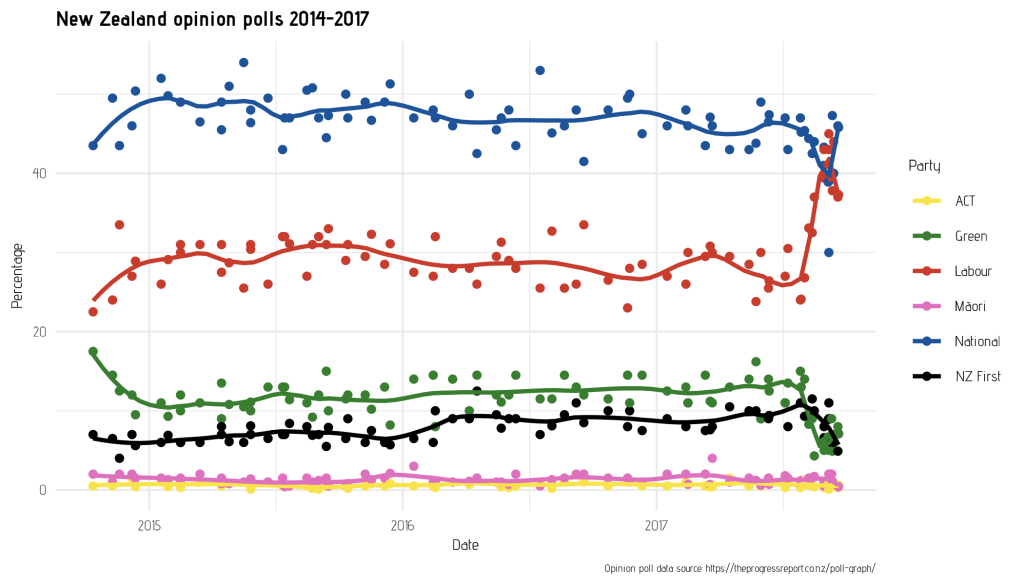
In the last term of the Fifth National Government (2014-2017) the polls were pretty steady throughout the parliamentary term, and it looked like the party was cruising to a fourth term. At the last minute, however, “Jacindamania” led to a Labour surge which enabled them to form the next government. Additionally, all first-term governments saw their support drop over the course of the campaign period.
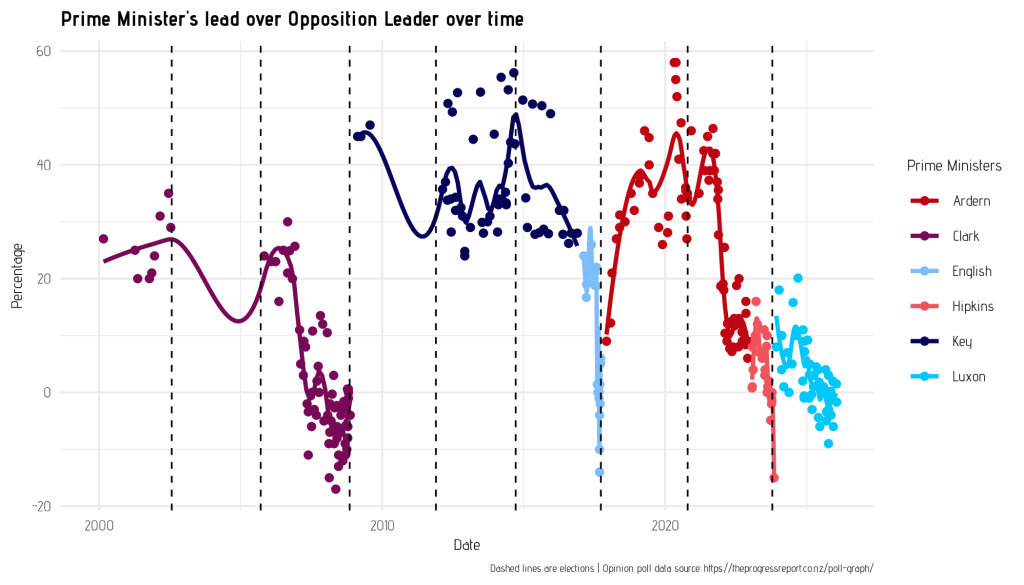
A major warning sign for the Luxon government is Christopher Luxon’s Preferred Prime Minister numbers. Having started off very low compared to recent PMs, Luxon is now typically roughly level with Chris Hipkins (Labour) on this measure. In the MMP era, every election that has resulted in a change of government coincided with the PM falling behind the opposition leader in Preferred PM polling.
Two Party Decline
New Zealand’s party system has entered an era of bloc politics which is somewhat new for the MMP era. While ACT has always been National-friendly and the Greens have always been Labour-friendly, the other minor parties had the potential to support either party in government.
But in the lead up to the 2023 election, a loose bloc system emerged between the parliamentary parties. With New Zealand First (*) and Labour refusing to work with each other, that left National and ACT (libertarian) as their natural governing partners. Te Pāti Māori (Indigenous), meanwhile, moved to the left and so any deal between them and National was mutually ruled out.
Bloc systems aren’t permanent but can last a while and may get embedded as part of the party system. While it’s too early to say what will happen in New Zealand, there are some indications that it may stick around.
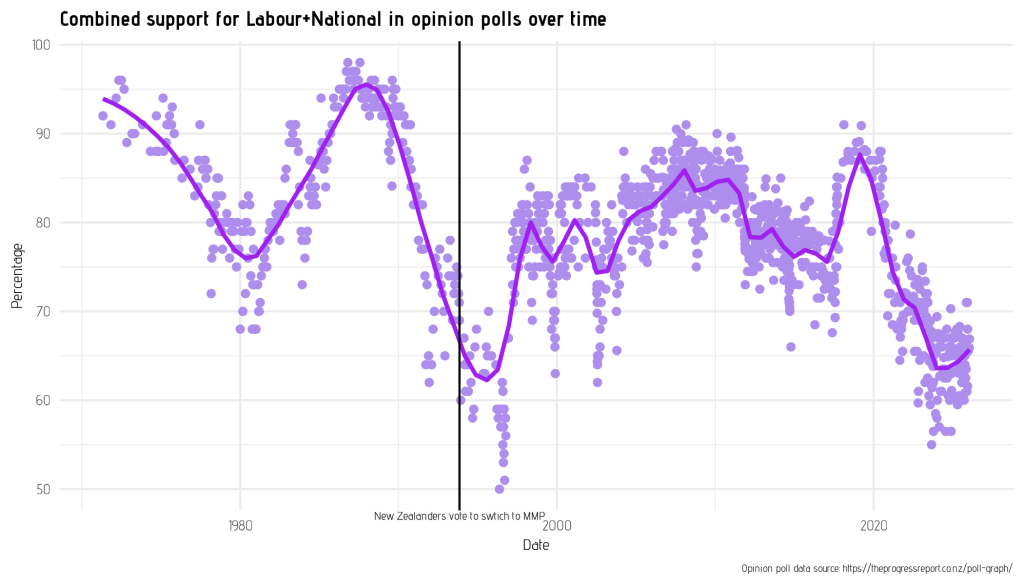
Support for the two major parties, Labour and National, has collapsed since 2020. Though this isn’t the first time this has happened, one reason it might be different is that support for ACT and New Zealand First hasn’t declined. Two years into the Luxon government and ACT’s support is stable, and NZ First are up a few points, the first time their support hasn’t declined after entering government.
In MMP, with the exception of the Green Party, minor parties in government (or in a confidence and supply arrangement) have tended to lose support quite rapidly after the election. Yet, for now, that trend seems to be gone.
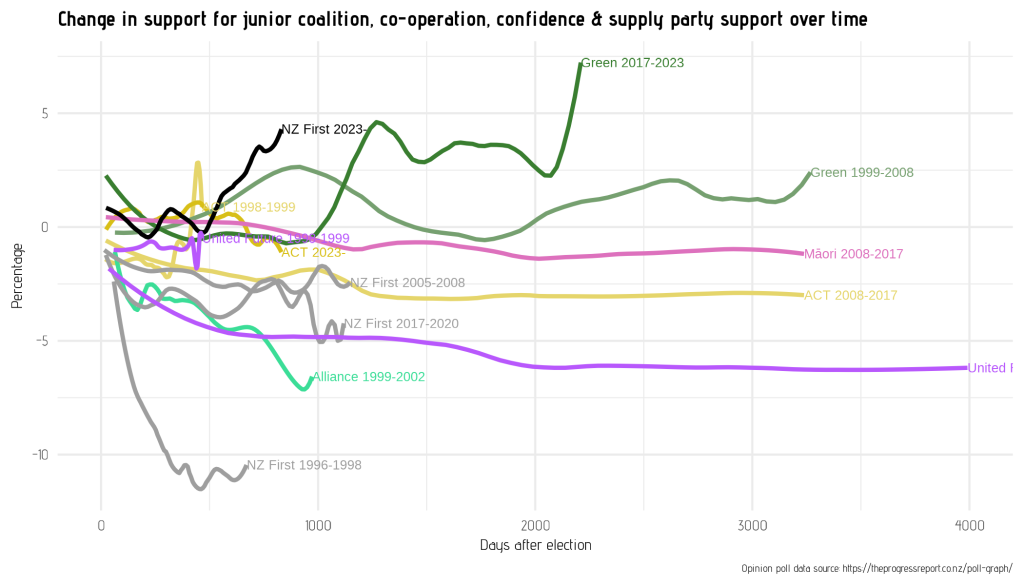
One theory might be that the coalition infighting actually helps give minor parties more of a clear identity as opposed to just a protest vote that doesn’t have any use once they become a party of government. If third parties stick around even after entering government, then that makes it more difficult for the big two parties to go back to their old levels of support.
Overall, Luxon does currently remain on track to be re-elected, but this is a very different first-term government to what we have normally seen in modern New Zealand politics. The government has seen its support decline rather than increase, and its junior coalition parties are enjoying stable, if not increasing, support compared to National. This is setting up the election on 7 November 2026 to be one of the more unpredictable elections.